





If you’ve ever wondered what actually happens behind those perfectly timed posts and on-brand replies, this one’s for you.
A day in the life of a modern social media manager is nothing like the outside world imagines. Social media management used to be a task someone in marketing just squeezed in between other things. Now it’s a whole job, and not an easy one.
This blog walks through what a typical day looks like for a modern social media manager: the tasks, the tools, the mental load, and how the best ones use social media management apps to keep it all together. Whether you’ve been at this for years or you’re still finding your footing, here’s what the job really looks like from the inside.
What the Social Media Management Really Involves
Behind every post you double-tap, a social media manager is making a hundred small decisions.
The job touches more of the organization than most people realize. Unlike other marketing roles where you can batch your work and log off, social media doesn’t stop.
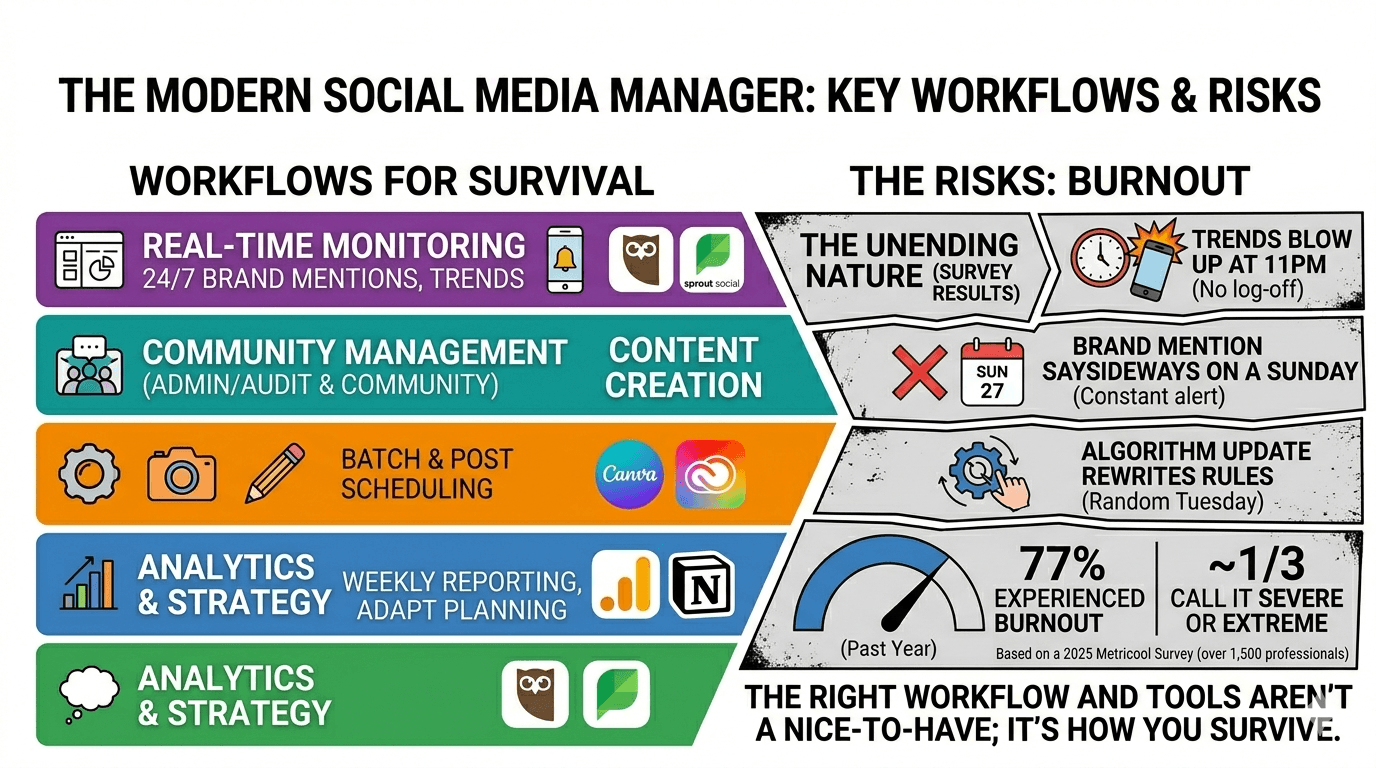
Trends blow up at 11 PM. A brand mention goes sideways on a Sunday. An algorithm update rewrites the rules on a random Tuesday. It all adds up.
A Metricool report based on a survey of over 1,500 social media professionals in early 2025 found that 77% experienced burnout in the past year. Nearly a third called it severe or extreme.
This is a structural problem, which is exactly why having the right workflow and the right tools isn’t a nice-to-have. It’s how you survive the job.
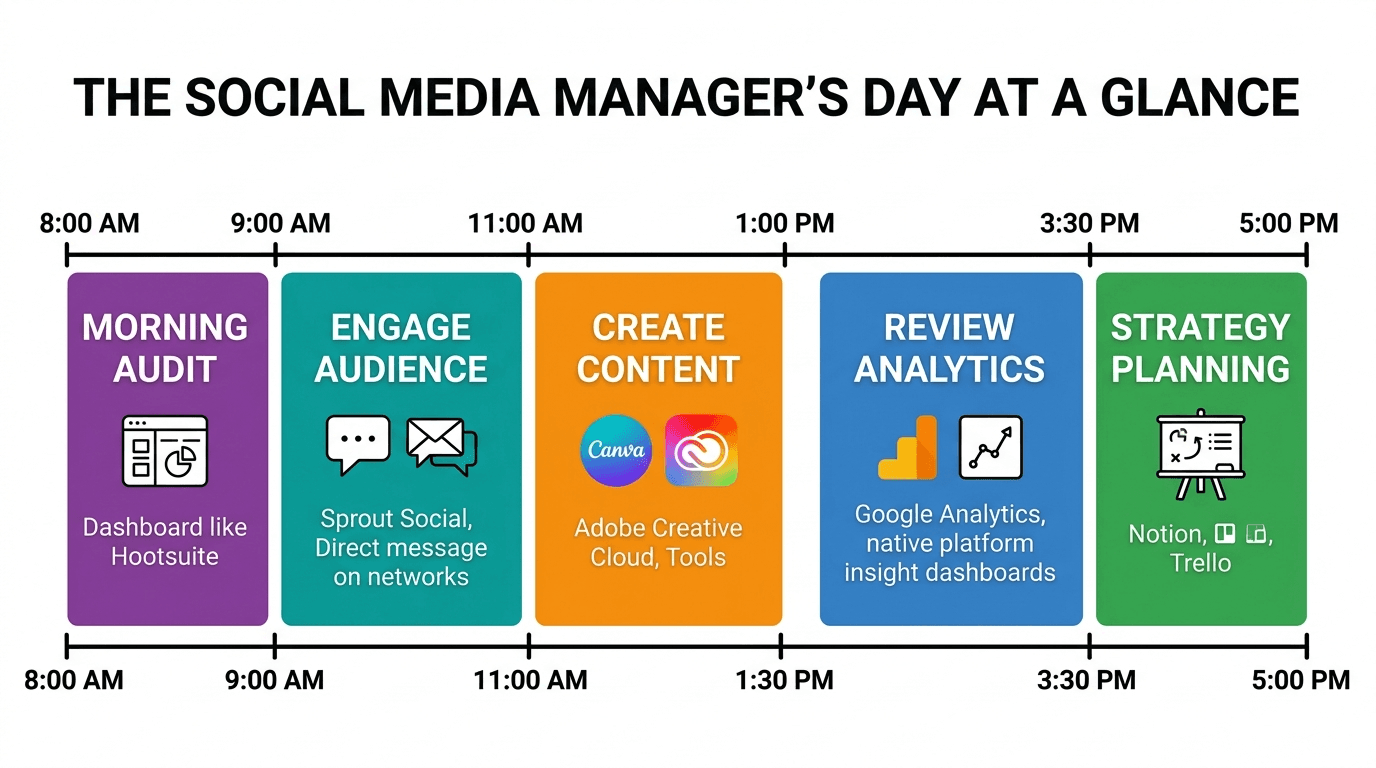
8:00 AM - The Morning Audit
The modern social media manager doesn’t wake up and open each platform individually. They open their social media management app.
Here’s what a smart morning audit covers:
Notifications triage: DMs, comments, tags, and mentions across all platforms
Scheduled post check: Did everything go out as planned? Are there any formatting issues?
Brand monitoring: Any overnight mentions, reviews, or conversations worth flagging?
Quick analytics pulse: First things first, how did yesterday’s content perform?
9:00 AM - Community Management
Community management is also a big part of the day: liking, commenting, and sharing posts from followers, partners, and peers. Do it well, and you’re not just feeding the algorithm; you’re actually building real relationships. Ignore it, and people notice.
A social media management app changes how this works. Instead of hopping between Instagram, LinkedIn, Facebook, and TikTok individually, everything lands in one unified inbox.
What good community management actually looks like:
Responding to questions with personality, not just answers
Acknowledging negative feedback quickly and routing it appropriately
Engaging with user-generated content that tags or mentions the brand
Participating in conversations in adjacent communities, and not just your own feed
Monitoring competitor comments for audience sentiment signals
10:00 AM - Content Creation
This is the part most people picture when they think about the job, and it really is a big chunk of it. But content creation in 2025 and 2026 looks pretty different than it did even two years ago.
At its core, the work involves writing copy, sourcing or creating visuals, scripting short-form video, designing graphics, and reformatting everything for each platform’s quirks and character limits.
The social managers who thrive use their management app’s content composer to draft, preview, and adjust posts natively, then queue them directly to the calendar without switching tools.
11:30 AM - Content Calendar Review and Scheduling

Great content means nothing if it goes out at the wrong time or doesn’t go out at all.
Scheduling in advance is one of those habits that just makes everything easier. Instead of posting on the fly every day, you batch it a week or even a month at a time.
A solid content calendar tracks more than just dates. We’re talking:
Post type (video, image, carousel, story, text)
Platform and account
Publish date and time
Campaign tags
Status (draft, in review, approved, scheduled, or published)
This is where an all-in-one management app like Sparkum really earns its keep. You can see the whole month at once and catch gaps in your coverage.
2:00 PM - Analytics and Performance Review
Afternoons are for digging into the data. That’s because you need content to actually be out in the world before the numbers mean anything. What a solid afternoon analytics session covers:
Post-level performance:
Reach and impressions by platform
Engagement rate (likes, comments, shares, saves)
Click-through rate on link posts
Video completion rates for Reels and TikToks
Story tap-forwards vs. drop-offs
Trend spotting:
What content types are crushing it this week?
Is there a format, topic, or posting time that keeps outperforming?
Any weird anomalies, a post that flopped despite strong creative?
Benchmark check:
Are you on track for this month’s follower growth targets?
How does this week stack up against the same period last month?
A good social media management app pulls all of this into one place. No more downloading CSVs from five different platforms and merging them into a spreadsheet. The best tools visualize trends, surface anomalies, and let you build client-ready reports in minutes.
3:30 PM – Strategic Planning and Ideation
This is the block that separates good social media managers from great ones. It’s also the first thing to get sacrificed when the day gets busy, so make sure you won’t let that happen.
Strategic planning covers a lot of ground:
Audience Research (Who’s Actually Engaging and What Do They Care About)
Keeping Tabs on Competitors
Noting Any Platform Updates Worth Testing
Building Out Your Ideas Bank for the Next Few Weeks
Mapping Out Upcoming Campaigns from Concept to Calendar
AI tools can help here too, especially for trend analysis, performance tracking, and early-stage brainstorming. They won’t replace your judgment, but they can take some of the grunt work off your plate.
This is the part of the day where you stop being a content producer and start being a brand builder. You’re looking at what the data is telling you and figuring out what the brand actually needs, then connecting those two things.
Strategic planning and ideation is the time that you should block. It’s the most commonly skipped block in a busy week, and skipping it consistently is how you end up with a following that grows but never converts.
5:00 PM – End-of-Day Checks
You’re not just closing the laptop and walking away. A quick five-minute wind-down keeps things from falling through the cracks and means tomorrow starts with context instead of chaos.
Here’s how you can do a quick end-of-day sweep:
Check for anything urgent that landed after lunch
Make sure tomorrow’s posts are queued up
Jot down any ideas from the day before you forget them
Peek at tomorrow’s calendar for deadlines or campaign dates
The habit that matters most here: stop checking social notifications after hours. Unless there’s an active campaign, event, or crisis situation, it can wait. The “always on” nature of the job makes burnout a real risk, and holding that boundary, actually holding it, is part of doing this job sustainably.
Conclusion
If you’re managing social for a brand or agency, take stock of where your time actually goes. If you’re spending more than 20% of your day on logistics, that’s workflow friction, not a creativity problem.
The right tool stack, anchored by a strong management platform like Sparkum, is the foundation. Everything else- the strategy, the content, and the community - gets better from there.