





Remember when “community management” was just something the social media manager squeezed in between scheduling posts and pulling analytics? For years, brands treated it as a background task. A few comment replies here, a quick DM response there, and call it done.
That era is officially over.
Community management has become one of the most important parts of a modern marketing team. With 5.24 billion people on social media and AI content taking over every feed, audiences are craving real human connection more than ever.
In this article, we’ll explore why community management has returned as a dedicated, full-time function rather than a side task for busy social media teams. We’ll look at the factors driving this shift, from algorithm changes and AI content overload to rising customer expectations, what modern community managers actually do, how dedicated community teams create business value, and the tools that help brands build stronger, more engaged communities at scale.
How Community Management Got Deprioritized

Back in the early days of social media, roughly 2010 to 2018, community management actually mattered. Brands hired dedicated moderators for their Facebook pages, forum threads, and brand communities.
Over time, a lot of companies just… lumped everything together. One person suddenly owned content calendars, design coordination, analytics, campaign launches, influencer partnerships, and customer engagement, all at once.
So, community management turned into an “I’ll get to it when I can” task instead of an actual priority.
Why Brands Are Reinvesting
A few things have happened all at once that made ignoring community management impossible to justify:
Algorithm pressure: Organic reach has been squeezed on every major platform. You can’t just post and hope anymore. Comments, replies, shares, and saves are engagement signals that now actually drive distribution. Basically, a dead comment section is a reach penalty you’re giving yourself.
AI content overload: Generative AI has made it way too easy to flood feeds with content that looks good but says nothing. People can feel the difference between a brand that’s just posting and one that actually engages. That authenticity has become a real edge quietly, but genuinely.
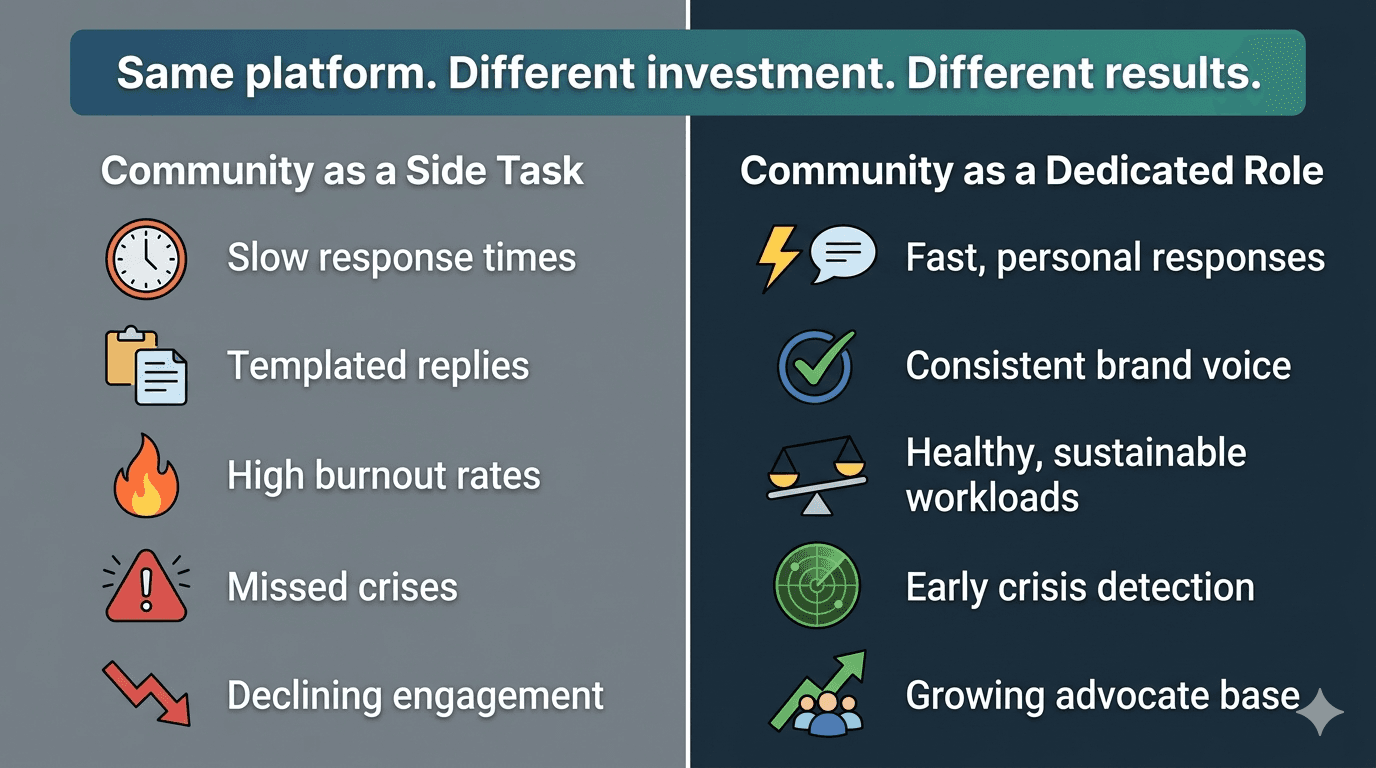
Raised expectations: People expect fast, genuinely human responses, not a templated reply three days later. When a brand ignores a question or complaint out in the open, it’s not just losing that one person.
What Community Management Actually Involves Today
It’s Far More Than Replying to Comments
When people outside the industry hear “community management,” they picture someone sitting at a desk liking posts and typing “Thanks for your feedback! 😊” That’s maybe 10% of the job.
A community manager today is working across a lot of dimensions at once:
Proactive engagement: By starting conversations, asking questions, highlighting community members, you give people actual reasons to keep coming back.
Real-time crisis management: Catching and defusing negative sentiment before it spirals, whether it’s a product issue, a PR moment, or a pile-on.
Community intelligence: Pulling real insights from community conversations that feed into product decisions, content strategy, and customer experience. It’s basically a live feedback loop.
Brand voice: Making sure every public interaction sounds like the brand consistently, across platforms.
Content collaboration: Spotting and amplifying user-generated content, nurturing brand advocates, and finding ways to actually build things with the community.
The “Always-On” Reality
One of the harder realities of community management is that it doesn’t have an off switch. Social media runs around the clock, and so do the conversations about your brand.
A product complaint posted Saturday night that nobody sees until Monday morning can easily turn into a PR mess by Sunday afternoon. According to a 2023 Sprout Social survey, 63% of social media managers say they’re burned out, which makes sense when one person is somehow expected to juggle all of this at once:
Content Creation
Strategy
Analytics
Paid Media
Community Management
This is precisely why leading organizations are separating community management into its own dedicated function. It’s definitely not to add headcount for headcount’s sake, but because trying to bolt it onto an already-overloaded role produces worse outcomes for everyone involved.
What a Full-Time Community Manager Does Differently

1. Building Systems, Not Just Responding
When someone’s dedicated to community full-time, they actually have the bandwidth to build the stuff that makes it all sustainable.
This kind of work is invisible when it’s running well. But when it’s missing? You notice the inconsistent tone, missed escalations, and negativity that goes unchecked. Those are all signs of a community that’s being managed reactively instead of intentionally.
2. Listening as a Real Strategy
One of the most underrated things a good community manager does is act as the brand’s ears. They are picking up on shifting sentiment, emerging concerns, and what’s actually resonating with people before it shows up in a report.
After social listening, they do something with it. A dedicated community manager feeds those insights back into product, content, and marketing strategy. That’s a genuine competitive advantage against the competitors.
3. Turning Followers into Actual Fans
Managing followers and building advocates are two completely different things. The goal of being a community manager is to move people from passively following to actively caring. Turning them to actual fans doesn’t happen on its own.
Tools That Make Full-Time Community Management Scalable
The Social Media Management Platform as Command Center
For social media managers already using a social media management platform, the community management evolution represents an opportunity to maximize the value of tools you already have. The best platforms do a lot more than scheduling. Look for:
Unified inbox: All your mentions, DMs, comments, and reviews in one place so nothing gets missed
Sentiment analysis and tagging: Incoming messages automatically sorted by tone, topic, or urgency so your team knows what to tackle first
Response templates: Fast, on-brand replies that don’t feel copy-pasted
Community health dashboards: Engagement rates, response times, top contributors, sentiment over time, all in one view
Team collaboration tools: Assign conversations, leave internal notes, manage escalations without things falling through the cracks
Building a Tech Stack for Community at Scale
Beyond your core social platform, a solid community tech stack usually includes:
Social listening tools to catch brand mentions outside your own channels
Community platforms like Discord for spaces you actually own
Customer support integrations to route conversations that need deeper follow-up
Analytics tools to measure ROI and give leadership something concrete to look at
Frequently Asked Questions
What is community management in social media?
It’s basically everything that happens after you hit post. Replying to comments and handling support are community management. It’s how brands actually become brands people like.
Why does community management matter more in 2026?
People are tired of talking to walls. They want responses, real ones, and they want them fast. The brands winning right now are the ones that actually show up.
How is community management different from social media management?
Social media management is the content side. It’s all about what you post, when you post it, and how it looks. Community management is the people side. The latter is about what you do once those people start responding.
What tools help with community management?
The most widely used are Sprout Social, Hootsuite, Buffer, and Agorapulse. Each has its own strengths depending on your team size and workflow.
Can AI replace community managers?
Short answer: no. It can handle the grunt work like sorting messages, drafting replies, and flagging what’s urgent. But knowing how to actually talk to people, read a room, and make someone feel heard? Still very much a human thing.
Conclusion
We’d love to hear from you! Is your team treating community management as a dedicated role, or is it still something that gets squeezed in around everything else?
What’s the biggest challenge you face in building a consistent community presence?
Drop your answer in the comments or share this article with a fellow social media manager. If your social media management platform isn’t supporting your community management workflows, it’s time to switch!
Check out Sparkum today. We have content, insights, and strategy all in one place. Our engagement and analytics features can help you build a community function that scales. Try now for free!
References
Talkwalker. (2025). Social Media Community Management: Your 2025 Playbook. https://www.talkwalker.com/blog/social-media-community-management
Marketing LTB. (2025). Community Marketing Statistics 2025: 99+ Stats & Insights. https://marketingltb.com/blog/statistics/community-marketing-statistics/
Planable. (2025). How to Build a Strong Community Management Strategy in 2026. https://planable.io/blog/community-management-strategy/
Brandwatch. (2025). What Is a Community Manager? Key Roles and Essential Skills. https://www.brandwatch.com/blog/community-manager/