





Something has quietly shifted for social media managers: AI content tools aren’t optional anymore. The market hit $2.14 billion in 2024 and is heading toward $7.81 billion by 2032. A lot of brands are putting real money behind this.
So what’s actually driving it? Here’s a look at why everyone’s investing, what the returns look like in practice, and what you should be thinking about.
The ROI Numbers That Actually Get Attention
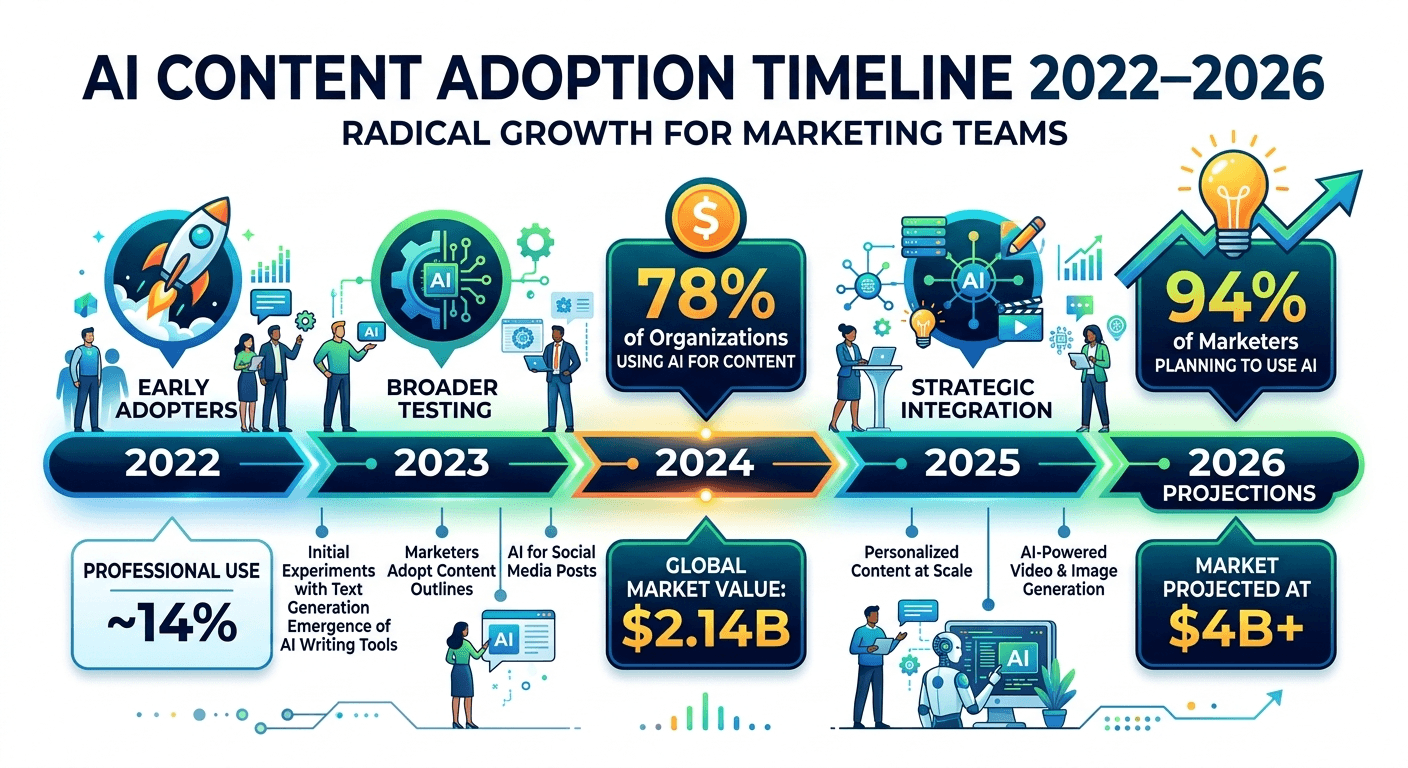
If there’s one thing that moved AI content from a marketing experiment to a C-suite priority, it’s the returns.
AI content tools are pulling 420% ROI, or probably one of the highest returns in the space. Imagine that you put in $10K, get back roughly $42K through time savings, higher output, and better engagement.
Here’s what’s actually driving it:
Measurable Time Savings
AI bumps productivity by 66% on average, with writers getting through work 59% faster. For social media managers, that’s real hours freed up for strategy and creative thinking that actually needs a human.
Better Engagement
AI-assisted content tends to perform. Email campaigns using AI see 41% higher click-through rates, and brands weaving AI into their content workflow report 32% better engagement across the board.
Doing More with Less
A two-person team can now put out what used to take ten people. 75% of US marketers say AI cuts costs, and if you’re running content across multiple markets or languages, those savings stack up fast.
Moving Faster
Trend windows on social are hours, not days. AI lets brands jump on a moment, like drafting, reviewing, and publishing, in the time it used to take just to write a brief.
68% of businesses say their ROI improved after bringing AI into their content workflow. 63% have grown their AI budgets. Only 2% are pulling back. The question in the boardroom isn’t whether to invest anymore; it’s how quickly they can scale.
Brand Voice at Scale
The biggest worry brands have about AI content? Losing their voice.
Will it sound generic? Will it produce copy that could belong to any brand? Will it slowly drift from the tone you’ve spent years getting right?
These are all fair concerns. But the AI tools have come a long way.
The Brand Voice Drift Problem
Brand voice drift happens when content gets made across multiple teams, channels, and tight deadlines without enough oversight.
One social post goes slightly off. An email sequence gets rushed. An ad uses different language than the website.
Six months later, your brand sounds like five different companies. It’s one of those slow-burn problems that gets worse the bigger your team gets.
How AI Actually Helps
Tools like Jasper, HubSpot’s AI suite, and Blaze AI have gotten pretty good at this. You feed them your existing content, and they pick up on your terminology, sentence structure, and how your tone shifts depending on what you’re writing, and not just “sounds friendly” but actually learn how you write.
In practice, the AI knows your brand sounds different in a technical product update versus an Instagram caption and adjusts without being told. Tools like Jasper’s brand voice feature even get better the more you use them.
For social media managers, that means you can tell the AI your brand sounds warm but not cheesy, confident but not arrogant, and expert but not intimidating. At times, the first draft will actually reflect that. You will still tweak it, but you’re not staring at a blank page.
How AI Supercharges Social Media Strategy
For social media managers, AI content tools aren’t just about writing faster. They’re changing how the whole job works.
Spotting Trends Before They Peak
Good AI platforms track social signals, search patterns, and engagement data to flag what’s gaining traction before it blows up. So instead of catching a trend on the way down, you’re in early.
82% of social marketers say they feel more on top of trends when using AI listening tools. And it shows: brands using AI for trend analysis are quicker to read the room, which means fewer “we should have posted about that” moments.
Smarter Scheduling
You don’t need to manually test post times anymore. AI tools look at your historical engagement, how your audience behaves, and platform signals to tell you the best time to publish. Some will just do it automatically.
Getting More Out of Every Piece of Content
This one’s underused: AI is really good at repurposing. One blog post or video can turn into a LinkedIn carousel, a few tweets, an Instagram caption, a newsletter blurb, and a short-form video script.
Each one actually fits the platform it’s going on. More content, same source material.
Comprehensive Analytics
AI-powered analytics have moved past likes and impressions. They connect content performance to real business outcomes, which makes it a lot easier to show leadership what’s working and why. 62% of social marketers already use social listening as a top priority; AI is just making those tools sharper.
AI Content Tools That Are Actually Delivering Results
The market is crowded, but certain categories of AI content creation tools have demonstrated consistent, real-world value for social media teams.
Writing and Copy Tools
Jasper is still one of the go-to tools for enterprise teams when it comes to brand voice memory, templates for pretty much any format, and it plays well with most marketing platforms. Teams have reported cutting time-to-publish by up to 80%.
Copy.ai and Writesonic do a lot of the same things at lower price points, which makes them a better fit for smaller teams and agencies.
Visual Content Tools
Canva’s AI suite has made design accessible to non-designers on social media teams, while tools like Runway ML are enabling video content creation at a fraction of traditional production costs. Lumen5 converts blog content and scripts into polished social video automatically, which is a powerful repurposing capability for time-strapped teams.
Social Media-Native AI Platforms
Predis.ai and Buffer’s AI features are built around what social media managers actually do every day. It works well for writing captions, finding hashtags, managing content calendars, and publishing across platforms.
Analytics and Intelligence Tools
Sprout Social, Sprinklr, and Brandwatch cut through the noise in your audience data: what’s resonating, when to post, and how people are reacting. Less time staring at dashboards, more time acting on what you find.
The Human + AI Hybrid Workflow That Actually Works
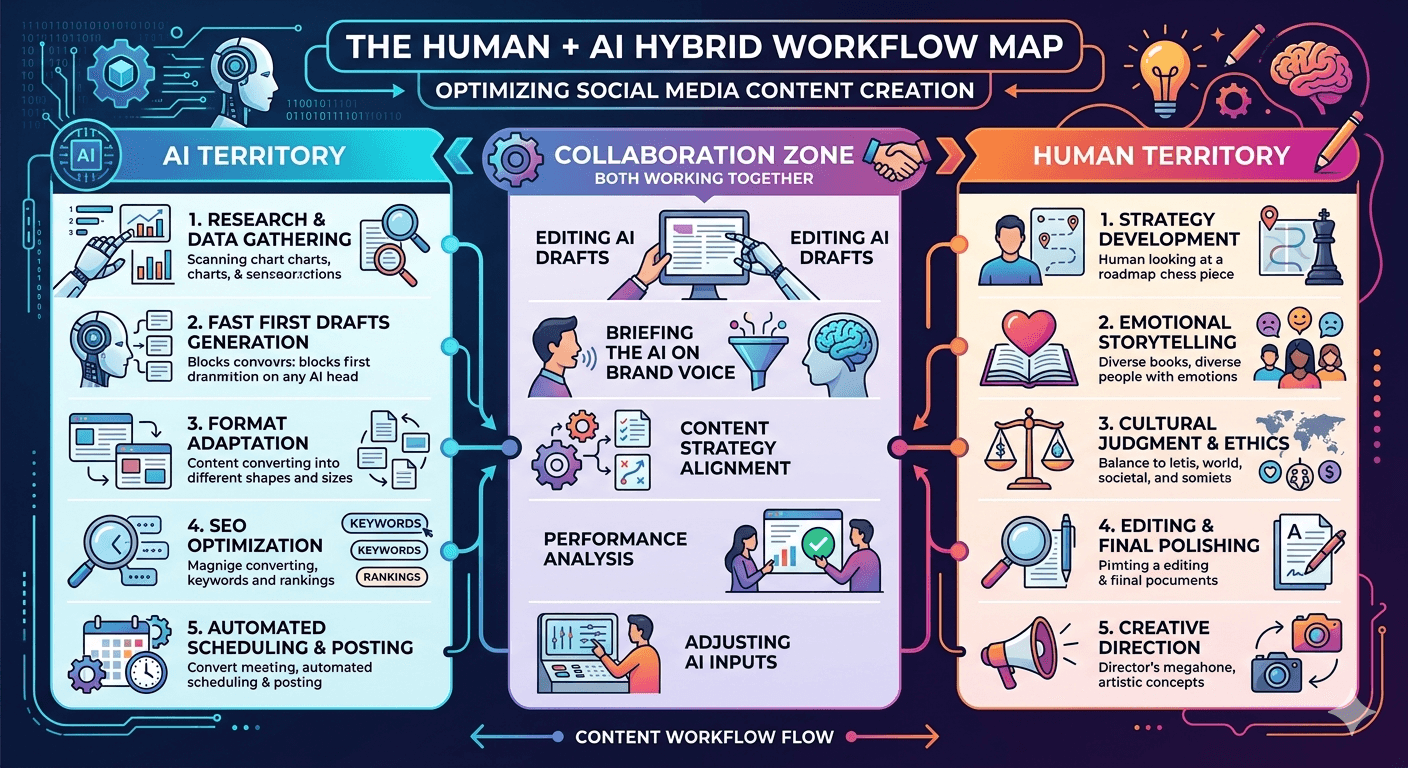
The brands getting the best results from AI aren’t the ones automating everything. They’re the ones who’ve worked out where AI genuinely helps and where a person still needs to make the call.
What AI Is Good At
Research: Scanning thousands of sources, pulling relevant stats, flagging what competitors are doing, done in minutes.
First drafts: Most creative time gets lost staring at a blank page. AI just gets you started.
Repurposing: Taking a long-form piece and breaking it into platform-specific snippets is the kind of repetitive work AI was made for.
SEO: When it comes to search intent, keyword suggestions, and content structure, AI is solid here and saves a lot of back-and-forth.
Consistency: It doesn’t produce worse work on a Friday afternoon than on a Monday morning.
What Still Needs A Human
Emotional storytelling: If you want content that actually moves people, that’s still coming from a person.
Strategic thinking: What to say, why, and how it fits the bigger picture are the things you can’t hand to a tool.
Cultural awareness: AI can miss context, misread a community, or not catch how a message might come across to a specific audience.
Conclusion
The question isn’t whether to invest in AI content tools anymore. It’s whether you can afford to keep putting it off. The gap between teams using AI and teams that aren’t is already showing up in output, consistency, and results.
Not sure where to start? Look at where your time actually goes. Find the highest-friction parts of your content process. Try one or two tools like Sparkum that tackle those specifically. See what the time savings and quality look like, then go from there.
Social media management is already a full-time job. Your tools shouldn’t make it harder. Sparkum gives you content, insights, and strategy in one place. Less switching, less scrambling, more doing.
References
DataM Intelligence — AI-Powered Content Creation Tools Market Size, Trends & Forecast (2026). https://www.datamintelligence.com/research-report/ai-powered-content-creation-tools-market
Affinco — AI Content Creation Statistics 2026: Adoption & Market Data (April 2026). https://affinco.com/ai-content-creation-statistics/
Sprout Social — 120+ Social Media Marketing Statistics for 2026 (May 2026). https://sproutsocial.com/insights/social-media-statistics/